AI Agent for HR Onboarding Automation: Retain Control
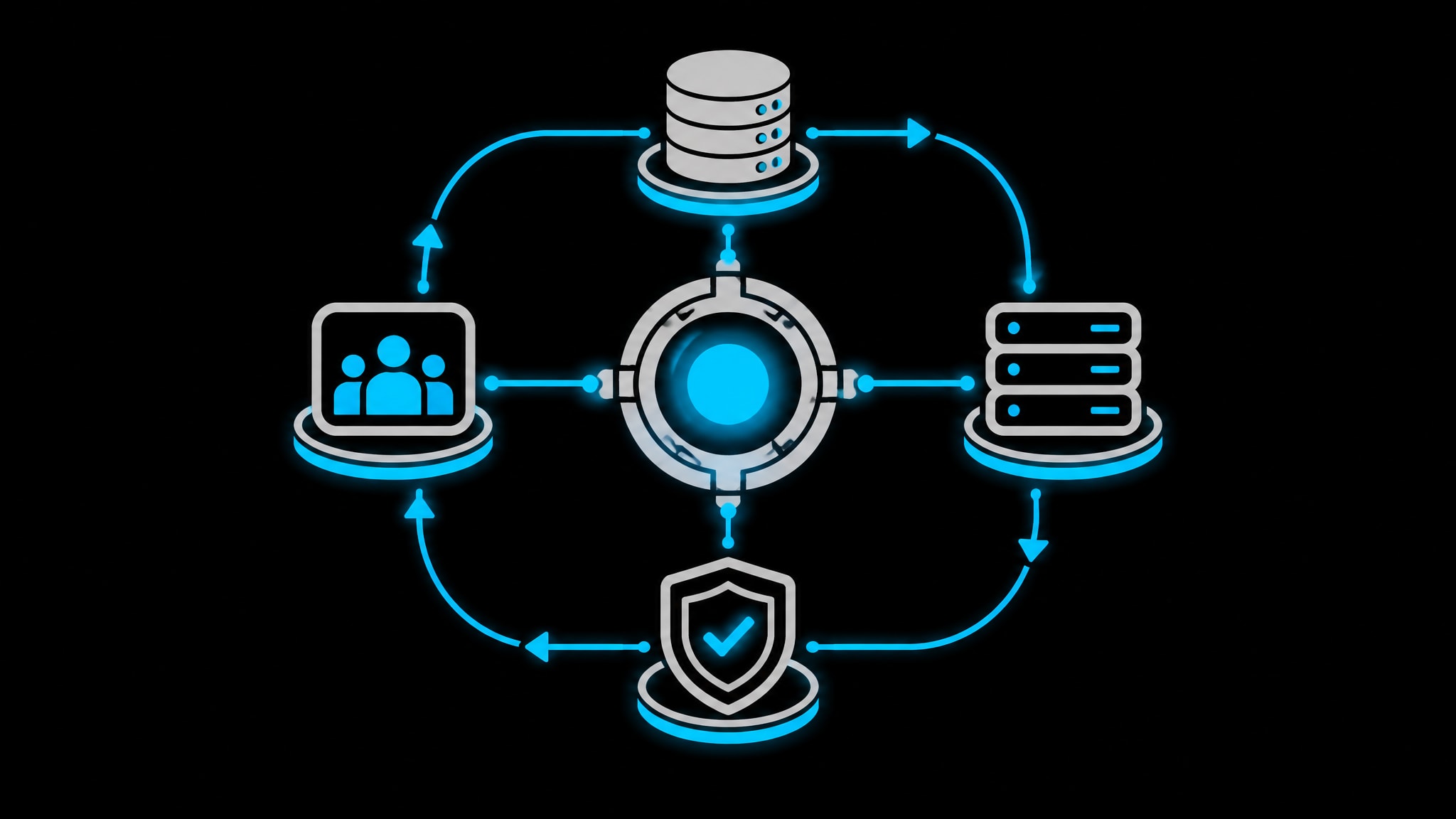
Most HR automation initiatives stall because they confuse conversation with execution. Enterprise decision-makers past the AI curiosity stage need practitioners who build and deploy deterministic systems, not advisors offering hand-wavy strategy decks that look good in a boardroom but fail in production. An effective AI agent for HR onboarding automation has to function as a verified operational component. It executes state changes across your HRIS and identity management platforms without constant human babysitting, and it doesn't generate plausible-sounding compliance errors.
JEH Consulting applies military-grade systems engineering discipline to translate disorganized HR operations into automated, closed-loop execution, not theoretical AI strategy. Onboarding isn't a series of conversational touchpoints. It's a logistics problem that demands precise coordination, auditability, and zero tolerance for unverified outputs. You need a system that collects documents, validates eligibility, and provisions access with the same rigor you'd apply to critical infrastructure, so every automated action stays traceable, reversible, and legally defensible.
Why Standard HR Automation Fails at Closed-Loop Execution
Standard chatbots run on probabilistic models built to predict the next likely word. That makes them fundamentally unsuitable for tasks where accuracy is binary and non-negotiable. Task an open-ended generative model with collecting sensitive PII or verifying employment eligibility, and you've introduced a liability vector that no amount of prompt engineering fully eliminates. The distinction between a conversational interface and an operational agent determines whether your automation creates capacity or creates risk.
The Gap Between Chatbots and Operational Agents
A chatbot responds to queries. An operational agent executes transactions. Closed-loop onboarding agents execute verified state changes across HRIS and IAM systems, which is exactly what separates them from open-ended conversational tools with no operational accountability. The agent doesn't merely suggest that a form has been completed. It writes the validated data to the database, confirms the write operation, and triggers the downstream provisioning workflow only after the target system sends positive acknowledgment.
Your current automation probably fails because it treats document collection as a messaging problem instead of a data integrity problem. An operational agent parses uploaded documents against structured schemas, rejects submissions that fail validation logic, and requests specific corrections based on field-level errors rather than generating vague conversational prompts. This deterministic behavior means the system never advances a candidate to the next stage until code, not language probability, has verified every prerequisite condition.
Compliance Risks in Open-Ended Generative Workflows
Unstructured generative outputs create unacceptable liability in document collection and identity verification, because nothing guarantees they'll match current regulatory standards. When an AI hallucinates a policy requirement or misreads a visa status during onboarding, the organization bears full legal responsibility for that error, regardless of the model's confidence score. You cannot defend a compliance failure in an audit by citing how sophisticated the underlying language model is.
Deterministic guardrails have to wrap every generative interaction, so the system can't make unauthorized commitments or hand out outdated guidance. That means separating the user-facing communication layer from the compliance logic layer: even if the conversational interface generates imperfect prose, the transactional engine underneath refuses to process invalid states. Without that separation, your AI agent for HR operations stays a novelty instead of a reliable piece of your compliance infrastructure.
Automating Document Collection and Compliance Checks with Precision
Precision in HR compliance automation demands architectures that put retrieval accuracy ahead of generative fluency. Practical AI workflow systems for HR need secure RAG and vector architectures grounded in vetted policy repositories, so compliance checks stay traceable and defensible. Architect these systems so every compliance decision points back to a specific, version-controlled source document, rather than leaning on the model's parametric knowledge, which degrades over time and can't cite anything.
Deterministic Validation for I-9 and Tax Forms
Government forms like the I-9 and W-4 carry strict formatting rules and logical dependencies that probabilistic models frequently miss. A robust onboarding workflow AI integrates directly with federal and state validation APIs to check document authenticity and data consistency in real time, rejecting submissions that fail programmatic checks before they ever enter your HRIS. That closes off the common failure mode where AI accepts a visually plausible but logically invalid form, and HR staff end up manually fixing errors days after the automated system marked the task done.
Validation logic has to be hard-coded and updated independently of the language model to keep compliance continuous. When regulations change, you update the validation ruleset, not the prompt. That gets you immediate, verifiable adherence to new requirements without retraining or regression-testing the whole model. This split between compliance logic and generative capability is what separates enterprise-grade automation from experimental prototypes.
Secure RAG Architectures for Policy Verification
Retrieval-Augmented Generation for HR needs a tightly controlled information boundary, so public training data never bleeds into proprietary policy. Your secure RAG implementation should index only approved, current policy documents, tagged with metadata that enforces role-based access during retrieval, so employees get guidance that matches their jurisdiction and employment classification. That stops the agent from surfacing California-specific leave policy to a Florida-based employee, or citing a superseded handbook version during compliance verification.
Every retrieval event needs a log entry: source chunk ID, relevance score, user context. That's what builds an auditable chain of custody for compliance decisions. When an auditor asks why the system approved a particular accommodation request, you can produce the exact policy paragraph and the retrieval timestamp behind it. Standard generative AI can't offer that kind of forensic traceability, and regulated HR processes require it.
Audit Trails as Non-Negotiable System Outputs
An AI agent for HR onboarding automation that can't produce a complete audit trail is functionally useless for enterprise deployment. Every state change, document validation, policy retrieval, and exception escalation needs an immutable log entry capturing the input, the processing logic applied, and the resulting output down to the millisecond. These logs double as operational diagnostics and legal evidence, proving the system stayed within defined parameters on every onboarding transaction.
Treat audit logging as a primary system requirement, not something bolted on after deployment. The logging architecture needs enough detail to reconstruct any onboarding session entirely from stored data, so post-incident analysis doesn't depend on volatile memory or half-complete application logs. That kind of record-keeping turns your AI agent from a black box into a transparent operational asset that holds up under regulatory scrutiny.
Provisioning Workflows: Integrating Identity Management and Access Control
Provisioning is the highest-risk automation point, because errors here grant unauthorized access or block legitimate employees from working. Your AI agent has to orchestrate account creation across multiple systems as a single atomic transaction, rolling back everything if any component fails, so you never end up with orphaned accounts or partial access states. This requires integration patterns borrowed from financial systems, similar to the closed-loop execution in accounts payable automation, where partial completion counts as total failure.
Orchestrating Cross-System Account Creation
Identity provisioning spans HRIS, Active Directory, SSO providers, and application-specific entitlement systems that rarely share native integration. Your onboarding automation needs an abstraction layer that normalizes these disparate APIs into one unified provisioning protocol, handling idempotency keys and retry logic so execution happens exactly once. Without that orchestration layer, race conditions between systems open security gaps: accounts exist in some directories but not others, or permissions pile up incorrectly after a failed rollback.
The agent has to verify successful provisioning at each step before moving on, treating API success codes as necessary but not sufficient confirmation. Real verification means reading back the created object from the target system and checking its attributes against the intended state, which catches silent failures where the API reports success but the account came out with wrong group memberships or a disabled status. The read-after-write pattern adds latency, but it kills the most dangerous class of provisioning errors.
Handling Exceptions and Role-Based Access Logic
Real-world onboarding rarely follows the happy path. Background check delays, contingent offers, and mid-process role changes break naive automation. Your agent has to hold state through these exceptions, pausing provisioning at defined checkpoints and resuming only once external dependencies resolve. That requires persistent workflow state storage, kept separate from conversational context, so the system survives restarts and handles multi-day holds without losing track of pending actions.
Role-based access logic has to handle organizational complexity: matrix reporting, temporary assignments, privilege escalation approvals. Hard-coding every possible role combination produces unmaintainable spaghetti code. Instead, build a declarative policy engine that evaluates access requests against dynamic rules drawn from HR attributes and approval chains. That lets business stakeholders change access policy through configuration, not through engineering tickets, every time the org chart shifts.
Maintaining Human Oversight in High-Stakes Onboarding Tasks
Automation without oversight is negligence, especially for regulated employment processes. Design human intervention points as explicit system parameters with defined triggers, not as optional best practices left to whoever's running the shift. Real oversight treats human review as a quality control gate inside the automated pipeline, and measures agent performance against operational SLAs rather than subjective satisfaction scores.
Defining Escalation Triggers and Approval Gates
Escalation logic should fire on measurable signals: validation failure rates above threshold, processing time variance beyond baseline, or a document type the training data has never seen. These triggers need to route cases to qualified human reviewers with full context intact, including the agent's reasoning trace and confidence scores at each decision point. Escalate without transferring context and you've just shifted the cognitive load, not reduced it, because the reviewer has to rebuild the case from scratch.
Approval gates for high-risk actions, final I-9 certification or privileged access grants, need explicit human authorization that no code path can bypass. The system should hand reviewers pre-validated evidence packages that flag anomalies and confirm routine elements, so human attention goes toward genuine exceptions instead of rubber-stamping normal cases. That targeted review model keeps compliance rigor intact while it keeps reviewers from burning out on monotonous approval queues.
Measuring Agent Performance Against Operational SLAs
Employee sentiment surveys measure perception, not operational effectiveness. Your KPIs should track first-pass yield rates for document validation, mean time to provision across employee cohorts, exception resolution cycle times, and audit finding frequencies per thousand transactions. These metrics show whether your AI agent for HR operations actually cuts administrative burden, or just redistributes it to a different team.
Baseline these metrics against your pre-automation manual process, running parallel tests during the pilot phase, so your improvement claims mean something. Without a comparative baseline, you can't tell whether a problem comes from the AI or was already baked into your onboarding workflow. Teams often struggle to interpret these operational metrics correctly, which is why closing the AI skills gap in operations teams matters for sustaining automation gains past initial deployment.
Evaluating AI Agent Vendors for Enterprise HR Operations
Vendor selection decides whether you get a sustainable operational capability or an expensive science project. Technical due diligence has to go beyond feature demos and examine the engineering practices, testing methodologies, and security architecture behind long-term viability. When evaluating AI agent development partners, favor vendors who can show production deployments in regulated environments over ones with slick demos and thin track records.
Technical Due Diligence Beyond Feature Lists
Ask for detailed documentation on prompt-system design, evaluation frameworks, and regression testing protocols, not marketing claims. Ask how the vendor handles model updates, what happens when upstream API providers change their terms, and how they verify continued compliance after infrastructure changes. Vendors building serious HR automation will have documented answers to these questions. Vendors treating AI as a wrapper around public APIs will deflect, or give you vague reassurances.
Look closely at how the vendor handles edge cases and failure recovery specifically in HR contexts. Generic AI platforms often assume stateless interactions and idempotent operations, assumptions that break badly once applied to sequential onboarding workflows with real side effects. Your technical evaluation should include scenario testing with deliberately malformed inputs, concurrent modifications, and partial failures, to confirm the system degrades safely instead of corrupting state.
Security Posture and Data Residency Requirements
HR onboarding processes highly sensitive PII under multiple overlapping regulatory regimes. Verify that the vendor's data handling matches your compliance obligations: encryption at rest and in transit, access logging, data retention limits, geographic residency restrictions. Certifications like SOC 2 Type II are table stakes. Dig into how they implement tenant isolation, manage encryption keys, and handle data deletion requests, to confirm their security posture actually matches their marketing.
Confirm the vendor's incident response procedures and breach notification timelines match your legal obligations. When, not if, a security event happens, you need contractual guarantees on investigation support, forensic data preservation, and regulatory communication assistance. A vendor unwilling to commit to specific response SLAs in writing is telling you they view security as a sales objection, not an operational imperative.
Operationalizing AI Onboarding: From Pilot to Production Deployment
Deployment strategy matters as much as technical architecture for getting sustainable automation outcomes. Start by structuring an AI agent pilot program that proves reliability in low-risk workflows before you scale to full compliance tasks. This phased approach de-risks adoption, building performance benchmarks and organizational trust through demonstrated competence instead of promised capability.
Run parallel processing during the pilot, with manual and automated workflows executing side by side for comparison. This shadow mode surfaces discrepancies between expected and actual agent behavior without touching real employees, and gives you safe learning and calibration data. Only promote a workflow to production once it hits predefined accuracy and reliability thresholds consistently, across a statistically significant sample, and resist the pressure to speed up the timeline based on a few early wins.
Build feedback loops between operations and engineering to keep refining agent behavior based on what production actually shows you. Document every exception, false positive, and user workaround as a potential system improvement rather than a one-off incident. That operational learning cycle turns your AI agent from a static product into a capability that keeps adapting to your organization's own patterns and edge cases.
Strategic Alignment: Connecting Onboarding Automation to Business Outcomes
Technical implementation has to connect directly to measurable business value, or it won't keep getting funded. Focus on operational KPIs: reduced time-to-productivity for new hires, lower administrative overhead per onboarding transaction, better compliance audit pass rates. Generic efficiency claims don't hold up the way these do. These metrics show concrete capacity gains that translate into headcount optimization, faster revenue from new employees, or less regulatory exposure.
Calculate ROI from actual operational data out of your pilot, not industry benchmarks or vendor projections. Include the hidden costs: exception handling time, system maintenance overhead, training requirements. Skip those and you'll overstate the benefit. Honest ROI math sometimes shows that certain workflows aren't ready for automation yet, and catching that early saves you from the sunk cost fallacy that kills broader AI initiatives.
Align automation scope with strategic HR priorities: better first-week experiences that improve retention, or geographic expansion without a proportional staffing increase. When AI onboarding serves an explicit business objective, rather than existing as technology for its own sake, it earns sustained executive sponsorship and budget. Review operational signals indicating readiness for AI agents periodically, so your automation roadmap stays in sync with organizational maturity and market conditions.
Frequently Asked Questions
How do deterministic AI agents differ from standard chatbots for compliance tasks?
Deterministic agents execute verified state changes through hard-coded validation logic and API integrations, treating onboarding as a transactional process with binary success criteria. Standard chatbots generate probabilistic responses optimized for conversational fluency, making them unsuitable for compliance-sensitive tasks where accuracy must be guaranteed rather than likely. The architectural distinction ensures deterministic agents refuse to advance workflows until all prerequisites are programmatically verified.
What prevents AI hallucinations during document validation and identity verification?
Secure RAG architectures grounded exclusively in vetted policy repositories prevent hallucinations by restricting the agent's knowledge base to approved, version-controlled sources with metadata-enforced access controls. Deterministic validation logic runs independently of the language model, checking documents against regulatory APIs and structured schemas before any generative processing occurs. Every compliance decision includes source citations and retrieval timestamps, creating an auditable chain of custody that exposes fabricated information immediately.
How should we structure human oversight gates in automated provisioning workflows?
Define explicit escalation triggers based on measurable signals like validation failure rates, processing time variance, or novel document detection rather than leaving oversight to operator discretion. Implement mandatory approval gates for high-risk actions that require human authorization with pre-validated evidence packages highlighting anomalies. Measure oversight effectiveness through operational SLAs tracking exception resolution cycle times and audit finding frequencies, not subjective satisfaction scores.
What security capabilities must an AI onboarding agent have for PII handling?
The agent must implement encryption at rest and in transit, tenant isolation, geographic data residency controls, and comprehensive access logging capturing every retrieval and state change. Verify vendor incident response procedures include specific SLAs for breach notification, forensic support, and regulatory communication assistance. Certifications like SOC 2 Type II are minimum requirements; conduct technical due diligence on actual implementation of key management, data deletion, and cross-tenant isolation mechanisms.
How do we measure ROI of AI onboarding agents beyond employee satisfaction?
Track operational KPIs including first-pass document validation yield rates, mean time to provision across employee cohorts, exception resolution cycle times, and compliance audit finding frequencies. Calculate ROI using actual pilot data comparing automated versus manual baseline performance, including hidden costs like exception handling and system maintenance. Connect technical metrics to business outcomes like reduced time-to-productivity, administrative overhead reduction per transaction, and improved regulatory compliance pass rates.