AI Workflow Automation for Operations Requires Closed-Loop System Design
Most organizations chasing AI transformation share a common failure pattern: they buy a capable tool, integrate it into an existing process, and call it automation. What they've actually built is a faster version of the same broken workflow. AI workflow automation for operations is not about deploying a model, it's about designing a system where every step from trigger to output is connected, logged, and capable of correcting itself. That distinction is the difference between a demo and a production-grade operational system.
Why Most AI Automation Initiatives Stall at the Tool Layer
Organizations that treat workflow automation as a software procurement problem almost always hit the same failure mode: the tool works, but the system doesn't. The model performs, document summaries are accurate, classification is fast, but the workflow still breaks because intake is manual, routing is ad hoc, and no one defined the exception path.
The Tool-First Trap
Tool selection should be the last decision in workflow design, not the first. When teams lead with the tool, choosing an LLM vendor, a no-code automation platform, or a vector database before mapping the process, they're building the roof before the foundation. The result is a patchwork of capable components with no coherent system connecting them. Triggers are undefined. Handoffs between steps are manual. Error states have no recovery path. Audit trails don't exist.
This trap is common precisely because tools are visible and vendors are loud. System design is harder to sell on a slide deck, but it's the only thing that makes automation durable.
What Closed-Loop Automation Actually Requires
A closed-loop automation system requires four things that no tool ships with out of the box: a defined trigger that initiates the workflow, explicit routing logic that moves outputs through the correct path, a mechanism for error detection and recovery, and a logged audit trail that makes every decision reviewable. Without these, you don't have automation, you have a tool that requires a human operator to function as the missing system.
The Architecture of AI Workflow Automation for Operations
Production-grade AI workflow automation for operations is a layered architecture. Each layer is independently testable and replaceable. If you can't swap out a component without rebuilding the whole system, the architecture is wrong.
The Four Control Points Every Operational Workflow Needs
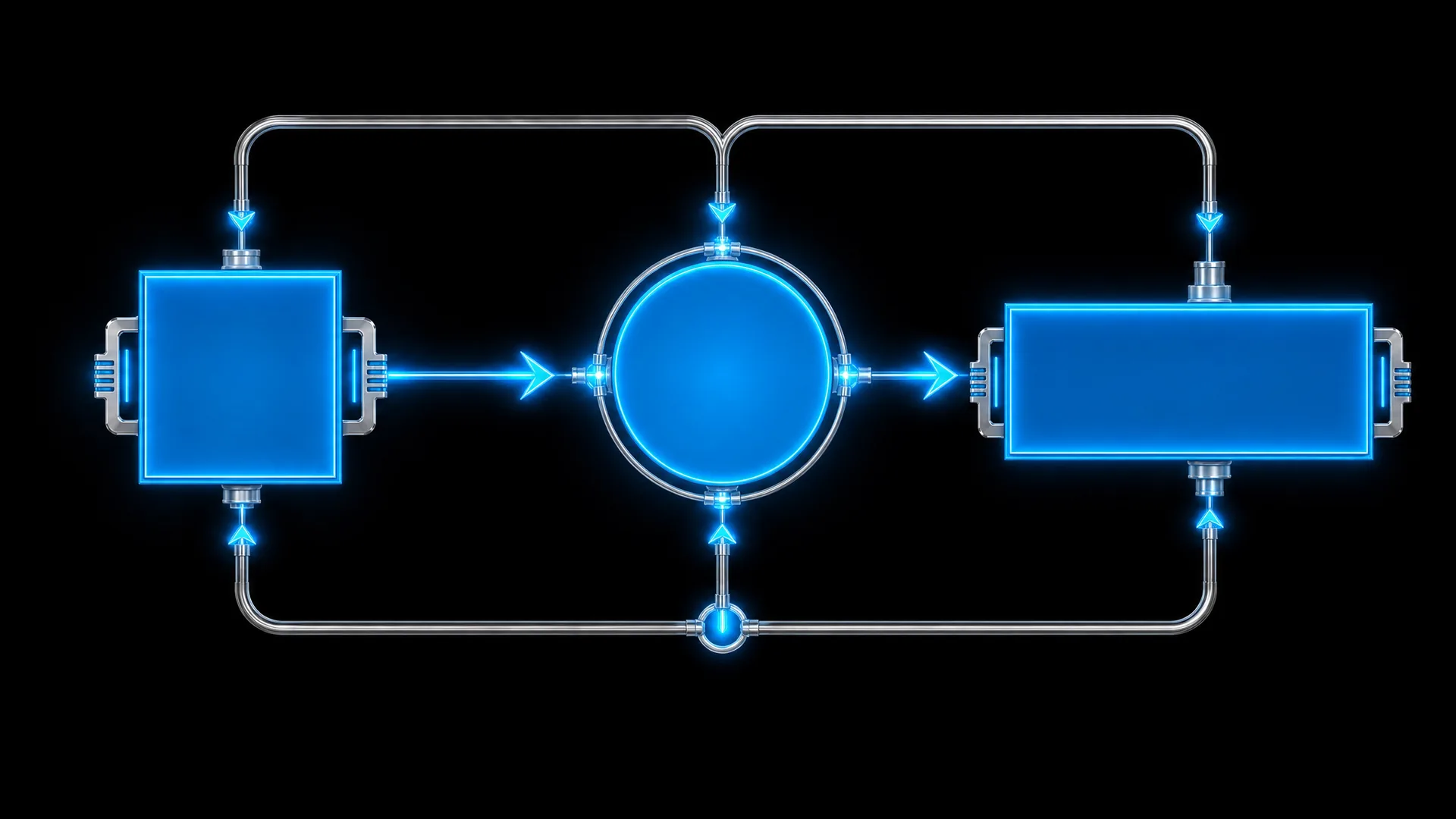
Every operational workflow, regardless of domain, passes through four control points:
- Intake / Trigger, the event or condition that initiates the workflow. This is a webhook, a scheduled job, a form submission, an API call. It must be deterministic and logged.
- AI Inference Layer, where an LLM, a retrieval-augmented generation system, or a classification model processes unstructured or ambiguous input. This is the only layer that is probabilistic.
- Decision-Routing Layer, rule-based logic that takes the model's output and routes it to the correct downstream action. Compliance thresholds, escalation triggers, and branching conditions live here. This layer is deterministic.
- Output / Action + Feedback, the system writes to a database, sends a notification, updates a record, or escalates to a human. Every action is logged. The log feeds back into the system as a reviewable record.
These four structural layers for operationalizing generative AI form the skeleton of any closed-loop operational system.
Deterministic vs. Probabilistic Steps: Where Each Belongs
This distinction matters more than any other architectural decision. Probabilistic AI inference, LLMs, embeddings, retrieval, handles ambiguity well. It does not handle compliance, audit requirements, or binary routing logic well. Those belong to deterministic rule layers.
A common enterprise pattern is deploying an LLM for document review while leaving the intake, routing, and escalation paths entirely manual. The model performs; the workflow still breaks. The fix is not a better model, it is closing the loop: automated intake, model inference, rule-based routing, logged output, and a human-in-the-loop escalation trigger where risk thresholds demand it.
AI handles the ambiguous middle. Rules handle the edges that must be predictable.
Operationalizing AI Workflows: From Map to Closed-Loop Execution
Operationalizing AI workflows is a methodology, not a migration. It starts before any tool is selected.
Process Decomposition Before Automation
JEH Consulting's engagements consistently begin with process decomposition, not tool selection. Every workflow is mapped to discrete, auditable steps before any AI component is introduced, ensuring the system is deterministic where it must be and adaptive only where ambiguity is unavoidable.
Decomposition means breaking a process into its smallest functional units: what initiates this step, what data it requires, what decision it produces, and what happens next. Each unit is evaluated separately, is this step a good candidate for AI inference, or should it be a deterministic rule? Can it fail silently? What does recovery look like?
This analysis prevents the most expensive implementation mistake: automating a poorly defined process at scale.
Building the Feedback Loop
The most frequently cited failure point in enterprise AI implementations is not model accuracy, it is the absence of a defined feedback loop. When automated outputs have no mechanism for correction or review, errors compound silently until a business-critical failure surfaces them.
Closing the loop means every automated action produces a logged, reviewable output. That log is structured, queryable, and tied to the specific decision that generated it. When an output is wrong, the system can identify where in the workflow the failure occurred, whether in the inference layer or the routing logic, and correct it without rebuilding the entire pipeline. A feedback loop is not a nice-to-have. It is what separates automation from controlled automation.
Workflow Orchestration AI: Connecting Agents, Data, and Systems
Orchestration is what turns individual components into a system. Workflow orchestration AI manages sequencing, state management, and error handling across agents, data stores, and downstream APIs. Without an orchestration layer, you have components, not a workflow.
When to Use Custom AI Agents vs. Static Pipelines
Not every workflow needs an autonomous agent. Most don't. A static pipeline, where every step, branch, and output path is predefined, is more auditable, more predictable, and easier to debug than an agent-based system. Static pipelines are the right choice for high-volume, well-defined processes where the decision logic doesn't change.
Autonomous agents are appropriate when the workflow requires dynamic reasoning across variable inputs, when the sequence of steps cannot be fully predefined because the process branches based on what the agent discovers mid-execution. Even then, agents should operate within a bounded scope with explicit permissions and logged actions. For the specifics of building production-ready custom AI agents, the key constraint is always the same: autonomous does not mean unaccountable.
The retrieval layer, typically built on enterprise RAG implementation from a systems-engineering perspective, connects the inference layer to structured knowledge. Vector databases as the retrieval backbone for operational AI make it possible for agents and pipelines to query large internal knowledge bases with semantic precision, retrieving the right context rather than brute-forcing keyword search. That retrieval accuracy directly affects the quality of every downstream decision.
Business Process Automation AI: Operational Frameworks for Enterprise Implementation
Business process automation AI at enterprise scale is not a deployment problem, it's a governance problem. The technical components exist. What most enterprises lack is an operational AI framework: the container that makes automation safe to run, safe to scale, and safe to audit.
Governance and Auditability Are Not Optional
Governance designed in from day one looks different from governance retrofitted after deployment. Built-in governance means access controls are defined at the workflow level, not just at the application level. It means every model inference is logged with its input, output, and confidence signal. It means rollback is a first-class capability: if a workflow produces bad outputs, you can halt it, review the logs, correct the routing logic, and redeploy without losing the history of what ran before.
Auditability is not just a compliance requirement. It's what makes operationalizing AI workflows in regulated or high-stakes environments politically viable. Operations leaders can deploy automation with confidence when they can demonstrate, on demand, exactly what the system did and why. That demonstrability is built into the architecture, or it isn't built at all.
An operational AI framework also defines the human-in-the-loop boundaries. Not every step should be fully automated. The framework specifies which outputs require human review before action, at what confidence threshold escalation triggers, and who receives that escalation. These are design decisions, not operational afterthoughts.
How JEH Consulting Builds Operational AI Workflow Systems
JEH Consulting builds AI workflow automation for operations as a systems-engineering discipline. Engagements are not strategy decks, they are structured design and implementation projects that end with a working, auditable, closed-loop system.
A typical engagement begins with a workflow audit: mapping the target process to discrete steps, identifying where manual intervention is currently doing the work of a missing system, and defining the control points the automated system must satisfy. From that map, the architecture is designed, trigger logic, inference components, routing rules, output actions, logging structure, and feedback paths, before a single tool is selected.
Implementation follows the architecture. Tool selection is driven by system requirements, not vendor relationships. The resulting system is independently testable at each layer, documented for internal operations teams, and designed for rollback if any component underperforms.
JEH Consulting works with operations and technology leaders who have stalled after a tool deployment or are entering automation planning and want to avoid the tool-first trap entirely. The firm operates in the space between strategy and execution, where most consultants stop and where the real system-building work begins.
If your organization has AI tools that aren't producing operational results, or if you're scoping an automation initiative and need a systems-engineering approach rather than another vendor recommendation, contact JEH Consulting to schedule a workflow assessment. The output is a structured system design, not a deck.