Enterprise AI Integration Challenges
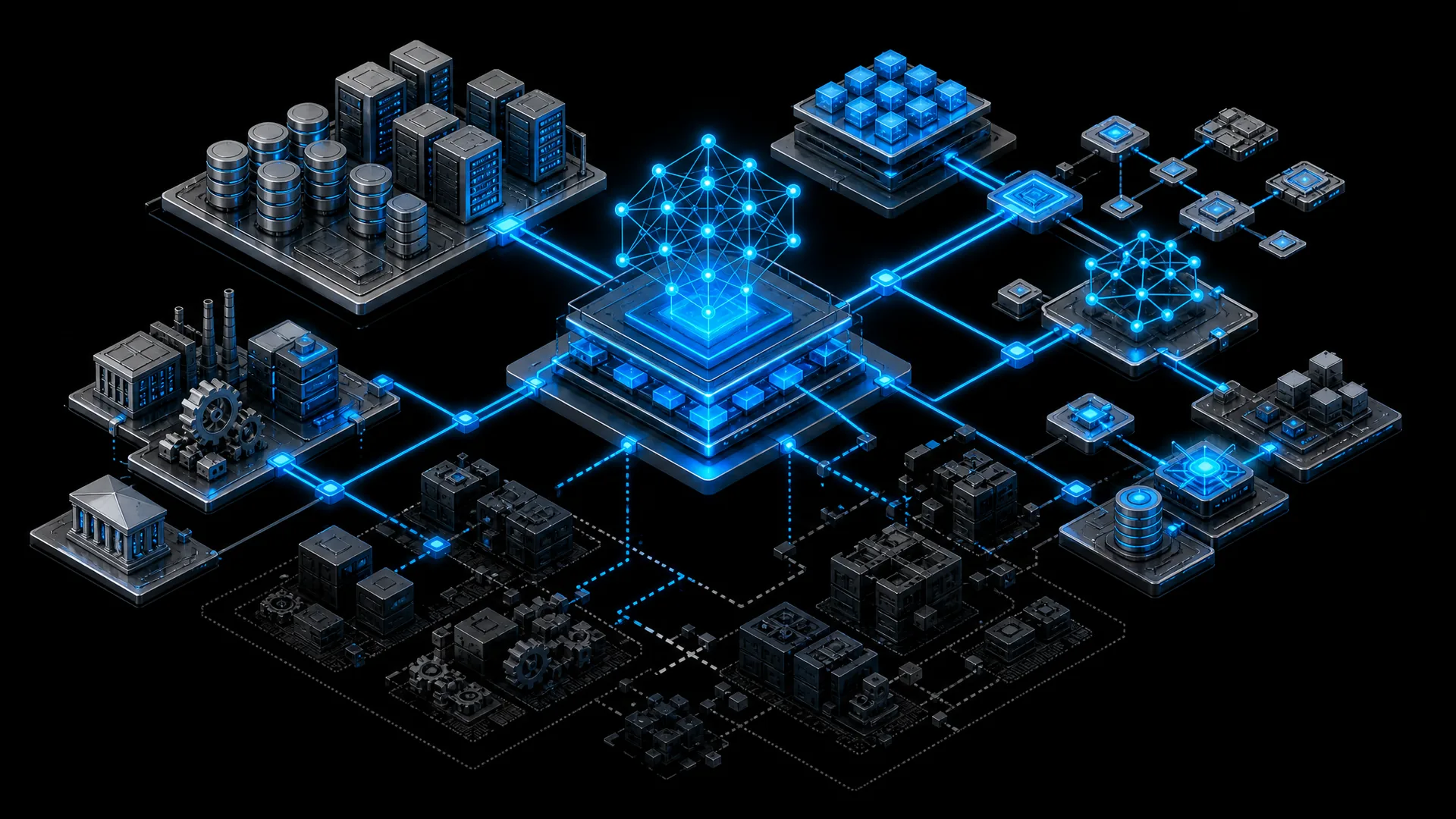
Enterprise AI integration challenges are not primarily a technology problem. They are a systems engineering problem, and most enterprises treat them like neither. They fund a model, run a pilot, and then discover that the real work is everything underneath: the legacy plumbing, the data pipelines, the security surface, and the org chart. That gap between pilot enthusiasm and production reality is where most AI initiatives die.
The following is a diagnostic. If you are a CTO or operations leader who has watched a promising AI deployment stall after proof-of-concept, the root cause is almost certainly one, or several, of the problems mapped below.
Why Enterprise AI Integration Fails Before It Starts
Most enterprise AI initiatives don't fail because the model is wrong. They fail because the integration architecture was scoped after the model was chosen, not before. The sequence matters more than the technology.
Treating AI deployment as a product launch, pick a model, build a demo, ship to users, skips the systems engineering discipline that defines whether production deployment is even possible. Aerospace and defense programs do not bolt capability onto existing infrastructure and hope for coherence. They audit the system first. Enterprise AI requires the same rigor.
Skip that step and the result is predictable: integration blockers surface one by one after go-live, each fix creates new fragility, and the system that looked clean in a demo becomes a maintenance liability in production. Technical decisions that define AI strategy implementation need to precede model selection, not follow it.
Legacy System AI Integration: The Coupling Problem
Mapping Your Dependency Graph Before You Touch Anything
JEH Consulting's enterprise engagements consistently surface legacy system coupling as the first integration blocker, not data quality, not security, because most clients have never audited the dependency graph beneath their core platforms.
ERP systems, CRMs, and mainframe pipelines are rarely self-contained. They carry decades of implicit dependencies: scheduled batch jobs, undocumented point-to-point integrations, shared database schemas that four different systems write to without coordination. Before any AI ingestion layer touches these systems, you need a full dependency map, which systems feed which, at what latency, in what format, and with what failure behavior.
Without that map, you are making assumptions. Assumptions about data freshness, about field semantics, about what happens when a source system goes offline. Those assumptions will fail in production.
API Gaps, Brittle Middleware, and the Cost of Assumptions
Legacy system AI integration fails most visibly at the API layer. Many enterprise core platforms, older ERP versions, custom-built CRMs, mainframe-adjacent applications, either lack modern REST APIs entirely or expose APIs that were never designed for the query patterns AI systems generate: high-frequency, non-deterministic, cross-entity lookups.
The stopgap is usually middleware, an integration layer or ESB built years ago to connect systems that couldn't speak to each other directly. That middleware is often brittle. It handles the exact transaction patterns it was designed for and breaks under anything else. Bolting an AI retrieval layer onto brittle middleware doesn't modernize the stack. It adds a new failure mode on top of existing ones.
The diagnostic question is not "does an API exist?" It is "can this API handle the load pattern, the query structure, and the failure recovery that an AI pipeline will generate?" The honest answer requires testing, not assumption.
Data Integration for AI: Garbage In, Garbage Out at Enterprise Scale
Why Data Quality Problems Are Architecture Problems
The most common framing of enterprise data problems is that they are a cleanup task, fix the data before the project starts, then proceed. This framing is wrong, and it causes AI deployments to fail.
Data quality in enterprise environments is not a static state you achieve and maintain. It is a continuous condition produced, or degraded, by the systems, processes, and humans that generate data every day. Siloed data stores accumulate inconsistent formats because different business units made different decisions at different times. Field semantics drift because no one enforced a schema contract across systems. Duplicates proliferate because master data management discipline was never fully implemented.
An AI system trained or retrieval-augmented on this data will reflect its quality exactly. Dirty inputs produce unreliable outputs, at enterprise scale, that means degraded outputs across every use case simultaneously.
Structuring Pipelines That AI Systems Can Actually Use
Good data integration for AI is not a pre-project cleanup sprint. It is an architectural commitment to ongoing data governance: defined schemas, enforced contracts at ingestion points, deduplication logic built into the pipeline, and lineage tracking so you know where every record originated and when it was last validated.
Concretely, that means building ingestion pipelines with transformation logic that normalizes formats before data reaches the AI layer, not after. It means defining what "current" means for each data source and enforcing freshness SLAs. It means treating the data pipeline as a production system with the same uptime, monitoring, and incident response discipline as any other production system.
AI workflow automation built on closed-loop system design depends entirely on this foundation. If the data flowing into automated workflows is unreliable, the automation amplifies the error, it doesn't contain it.
AI Security Integration: Access, Exposure, and Control Surface
Threat Modeling for AI Pipelines in Enterprise Environments
AI pipelines expand the enterprise attack surface in ways that conventional security models were not designed to address. Three threat vectors dominate.
Prompt injection allows adversarial inputs, whether from external users or malicious internal data, to manipulate model behavior, override instructions, or exfiltrate information embedded in the model's context window. This is not a theoretical risk; it is an active exploitation pattern.
Data exfiltration via LLM outputs is subtler. A model with access to sensitive enterprise data can be queried in ways that surface that data in generated responses, even when the data was never intended to be user-accessible. An LLM that can read HR records to answer policy questions can, under the right query, summarize individual compensation data in its output.
Over-permissioned retrieval layers are the most common failure mode in RAG deployments. A RAG deployment built without role-based access controls on the retrieval layer becomes a data exfiltration risk the moment a user queries across permission boundaries, a failure mode that generic AI pilots routinely skip past.
Mitigation requires threat modeling the AI pipeline as a distinct system, not applying perimeter security controls and assuming they cover it. For retrieval-augmented systems, that means securing RAG pipelines with threat models and access controls: document-level permissions propagated into the vector index, output filtering logic, and query auditing at the retrieval layer.
AI security integration is not a configuration step. It is a design discipline that has to be embedded in the architecture from the start.
Organizational AI Adoption: The Resistance You Can't Architect Around
Workflow Ownership, Change Management, and Accountability Gaps
Organizational resistance to AI adoption is consistently misdiagnosed as a culture problem, employees who don't trust the technology, managers who feel threatened by automation. Those dynamics exist, but they are symptoms. The structural cause is undefined ownership and accountability.
When an AI system makes a wrong call, misclassifies a support ticket, generates an incorrect report, routes a decision incorrectly, who is accountable? If the answer is "the AI," the organization has already failed. AI systems do not own outcomes. Humans do. When accountability is undefined at deployment, resistance is the rational response.
The operational fix is not a change management campaign. It is operationalizing AI governance controls through system architecture: explicit role definitions for every decision point the AI touches, documented escalation paths for low-confidence outputs, and closed-loop feedback mechanisms so that errors surface to accountable humans, not disappear into logs.
Systems engineering fundamentals for operations leaders frame this correctly: organizational AI adoption is a workflow redesign problem, and workflow redesign requires governance, not persuasion.
AI System Integration Architecture: Building for Production, Not Proof of Concept
The Four Layers Every Enterprise AI Integration Needs
Every diagnostic above points to the same conclusion: enterprise AI integration challenges are not solved by better models. They are solved by a sound integration architecture, the four structural layers for operationalizing generative AI that separate proof-of-concept from production-grade deployment.
1. Ingestion layer. This is where data enters the AI system. It must normalize formats, enforce schema contracts, validate freshness, and reject or flag records that fall outside defined quality thresholds. This layer is where data integration discipline lives. Without it, everything downstream is unreliable.
2. Retrieval layer. For RAG and agent systems, this is the vector store, the search index, and the retrieval logic that determines what context reaches the model. It must enforce document-level access controls, not session-level, document-level, and log every retrieval event for audit. Over-permissioned retrieval is a security failure, not a configuration oversight.
3. Execution layer. This is where the model operates, generating outputs, making classifications, triggering downstream actions. In agentic systems, this layer includes the orchestration logic that chains tool calls and manages state. It must include output validation: checking generated responses against defined constraints before they reach users or downstream systems.
4. Governance layer. This is the monitoring, alerting, escalation, and feedback infrastructure that makes the system self-correcting. Closed-loop agent systems that catch silent failures treat monitoring as a design requirement, not an operational add-on, because output quality degrades silently without it, and silent degradation destroys enterprise trust in AI systems faster than any other failure mode.
Proof-of-concept deployments typically build the execution layer and stop. Production deployments build all four, in sequence, before users touch the system. That sequence is the work.
If you are building toward production and following a five-phase generative AI roadmap for enterprise, the four-layer architecture maps directly to phases two through four, where integration depth, security controls, and governance mechanisms are established before scale.
Enterprise AI integration challenges are diagnosable. The blockers, legacy coupling, data quality debt, security surface expansion, accountability gaps, each have a specific structural cause and a specific engineering response. Most enterprises never solve them because they never run the diagnostic.
If your AI initiative has stalled in pilot or degraded after initial deployment, a systems audit will surface the exact point of failure. JEH Consulting runs structured integration diagnostics, not sales conversations, that map the dependency graph, evaluate data pipeline integrity, model the security surface, and identify the governance gaps blocking production. Book a diagnostic consultation to find out precisely what is blocking your deployment and what it takes to fix it.