Manual Workflow Automation With AI
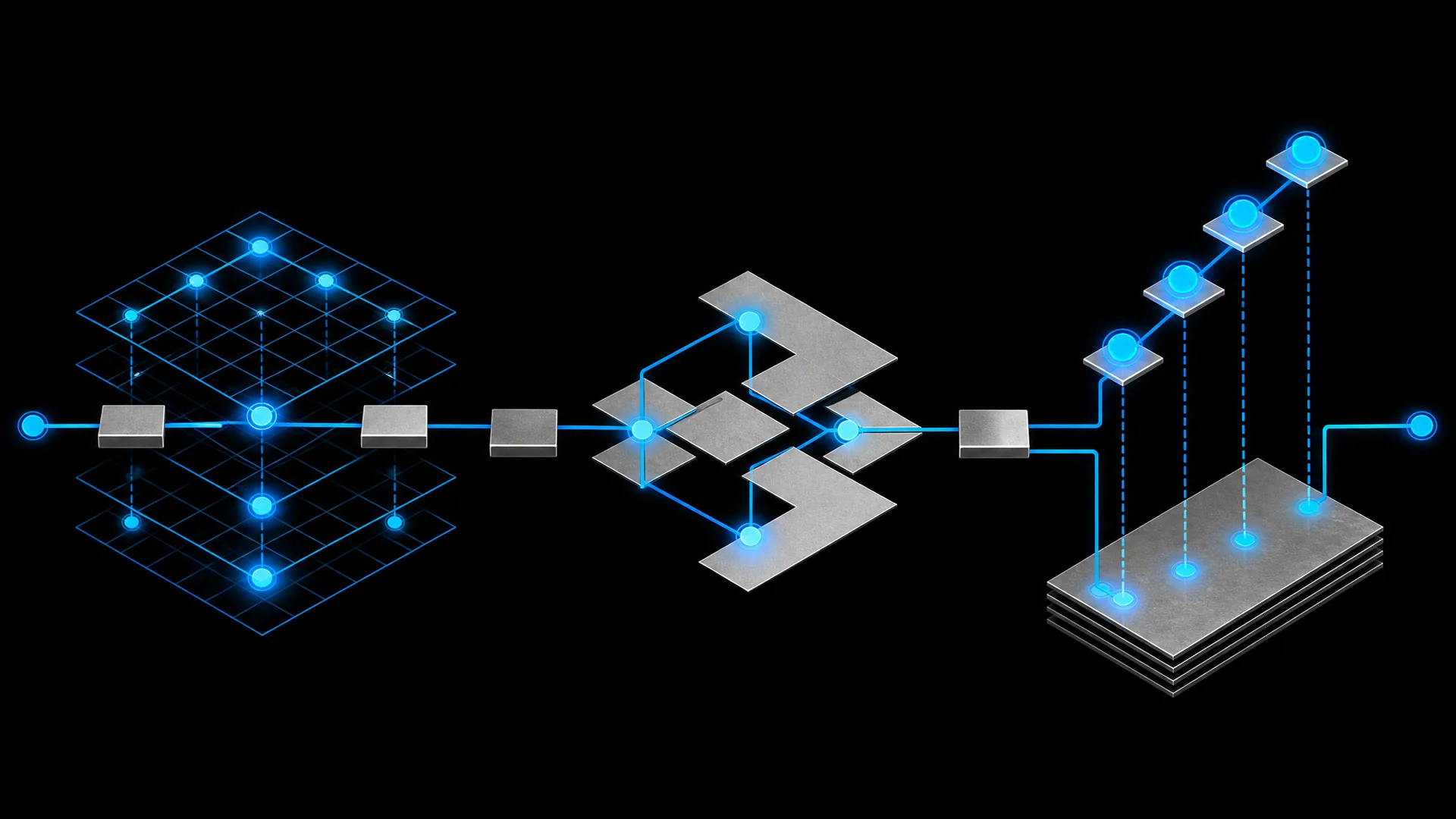
Manual workflow automation with AI is not a tool-selection problem. It is a process-characterization problem, and most organizations get that backwards. They deploy AI against workflows they haven't mapped, measure outputs they haven't baselined, and then wonder why cycle times barely move. The result is faster noise, not operational leverage. This article walks through the structured approach: audit first, design second, deploy third.
Why Most Manual Workflow Automation Efforts Fail Before They Start
Enterprise teams that skip workflow characterization and move directly to AI tool deployment routinely find that their automation cuts cycle time on the wrong steps, accelerating low-value tasks while the true bottleneck stays human-gated. That is not an AI limitation. It is a diagnostic failure.
The pattern repeats across industries: a team identifies a painful manual process, selects an AI tool that looks capable, and wires it in. Three months later, the tool is running fast, and the process is still slow. Because the constraint was never the step they automated.
The Real Problem Is Process Mapping, Not Tool Selection
Before any AI system touches a workflow, you need a documented process map that answers five questions: What triggers this process? What inputs arrive, in what form, and from where? What decisions get made, and how often? What exceptions break the expected path? Where does a human have to touch it before it can move forward?
Most organizations cannot answer all five. That gap is where automation projects die, not in model selection or prompt engineering, but in the absence of a clear operational baseline. Systems engineering fundamentals for operations leaders implementing AI starts with exactly this discipline: define the system before you touch the tooling.
Workflow Efficiency Analysis: How to Audit a Process Before Touching AI
A workflow efficiency analysis has four components: input/output mapping, decision frequency analysis, exception-rate classification, and human-in-loop dependency scoring. Run all four before evaluating any AI tool.
Input/output mapping documents every artifact that enters and exits each step, format, source, volume, and variance. If inputs are inconsistent in structure, the automation layer needs to handle that variance explicitly, or it will fail silently.
Decision frequency analysis counts how often a step requires a judgment call versus a deterministic action. High-frequency, low-complexity decisions are prime automation targets. Low-frequency, high-stakes decisions need human routing with AI support, not full AI ownership.
Exception-rate classification measures how often a process instance deviates from the standard path. A process with a 30% exception rate is not a simple automation candidate, it is a system design problem that AI alone will not solve.
Human-in-loop dependency scoring identifies which steps are human-gated because of policy, compliance, or genuine complexity, versus steps that are human-gated only because no one has built the system to remove that dependency.
Classifying Process Types for AI Suitability
Not every process belongs in the same automation category. A simple two-axis framework helps: plot processes on rule density (how explicitly the decision logic can be defined) versus data variability (how much the input data structure changes across instances).
High rule density, low data variability: full automation candidates. High rule density, high data variability: automation with structured preprocessing. Low rule density, low data variability: AI-assisted decision support. Low rule density, high data variability: human-led with AI augmentation only.
Most enterprise workflows cluster in the middle. The audit tells you which quadrant you're actually in, not which quadrant feels intuitive.
Bottleneck Identification: Where Human Effort Creates Systemic Drag
Bottlenecks in manual workflows are rarely where teams think they are. They show up in three predictable patterns: handoff latency (work sitting in a queue between steps), exception accumulation (non-standard cases piling up because no one owns the routing logic), and approval dependencies (a human signature required before downstream work can proceed).
Approval routing and exception triage are among the most commonly overlooked automation targets. They're invisible in process diagrams but account for a disproportionate share of cycle-time variance in most enterprise workflows. Map those first.
Identifying Automatable Workflows: The Criteria That Actually Matter
A workflow is genuinely automatable, not just apparently automatable, when it meets four hard criteria.
Repeatability: the process executes frequently enough that automation ROI is recoverable within a reasonable timeframe, and the steps are consistent enough that a system can be designed once and run many times.
Data availability: the inputs the AI system needs exist in structured or semi-structured form, at the right point in the process, with sufficient quality to drive a reliable output.
Decision auditability: every decision the AI makes can be logged, traced, and reviewed. If a process requires decisions that cannot be explained or audited, it is not ready for AI ownership, it needs governance design first. AI governance frameworks that operationalize controls through system architecture covers this layer in detail.
Latency tolerance: the process can absorb the processing time the AI system requires without breaking downstream dependencies. Real-time processes have different architecture requirements than batch workflows.
High-Signal Process Patterns Worth Targeting First
Three process archetypes consistently deliver the highest early ROI in business process automation AI engagements.
Document intake, invoice processing, contract review, compliance intake, ranks among the highest-ROI targets because these workflows combine high volume, structured data patterns, and low tolerance for manual delay. The inputs are repetitive, the decision logic is codifiable, and the cost of slow processing is measurable.
Approval routing takes structured requests, applies policy rules, and routes to the appropriate decision-maker or auto-approves within defined thresholds. The logic is explicit; the volume is high; the human bottleneck is unnecessary for the majority of cases.
Exception triage classifies process deviations, routes them to the correct handling path, and logs the outcome. Done manually, this work is slow, inconsistent, and invisible. Done with a well-designed AI system, it becomes a tracked, measurable operation.
AI Workflow Design: Building the System Architecture, Not Just the Prompt
Effective AI workflow design is a systems-engineering discipline. You are defining triggers, state management, handoff logic, and failure handling, not writing a clever prompt and hoping for consistent output.
Every automated workflow needs four architectural elements defined before build:
- Trigger: what event initiates the workflow, and what validates that the input is ready to process
- State: what information the system tracks across steps, and where that state lives
- Handoff logic: how work moves between AI steps and human steps, and what conditions govern each transition
- Failure handling: what happens when the AI output falls below confidence thresholds, when inputs are malformed, or when a step times out
This is AI workflow automation for operations requires closed-loop system design, the difference between a system that operates reliably in production and one that works in demo.
Closed-Loop vs. One-Shot Automation
One-shot automation takes an input, runs it through an AI model, and returns an output. It works well for generation tasks with defined structure: drafting a document from a template, extracting fields from a form, classifying an item against a fixed taxonomy. The output does not feed back into the same process.
Closed-loop automation monitors its own output, applies a confidence or quality check, and routes accordingly, escalating to a human reviewer when certainty is low, logging every decision and its outcome, and using that log to refine future handling. A closed-loop AI agent handling procurement exception triage monitors its own output confidence, escalates low-certainty decisions to a human reviewer, and logs the outcome, creating an auditable correction loop that one-shot generation cannot replicate.
Use one-shot for generation tasks where a human reviews output before it acts. Use closed-loop AI agent systems with feedback and monitoring wherever the AI output triggers a downstream action without human review in the loop.
Prompt-System Engineering and Deterministic Output Requirements
Prompts are not the system, they are one component of it. A production AI workflow requires deterministic prompt-system design for reliable AI output: structured input schemas, explicit output format constraints, validation layers that catch schema violations before they propagate, and version-controlled prompt logic that changes only through a controlled process.
Variability in AI output is not an inherent limitation. It is a design failure. When you need consistent, auditable decisions at scale, you engineer the system to produce them.
Process Automation ROI: What to Measure and How to Set Realistic Expectations
Process automation ROI is measured in operational metrics, not projected cost savings alone. Four metrics give you a genuine signal in the first 90 days.
Cycle time reduction: measure end-to-end process duration before and after automation, at the process level, not the step level. Step-level speed improvements that don't reduce overall cycle time are not ROI.
Error-rate change: track defect rates, rework frequency, and exception volume. Automation that reduces cycle time but increases error rate is net negative.
Labor reallocation: measure how much human effort shifts away from the automated steps. This is not headcount reduction, it is capacity freed for higher-complexity work. Capture where that capacity goes.
Escalation frequency: in any AI-assisted workflow, track how often the system escalates to a human. Declining escalation rates (without increasing error rates) signal that the system is performing well. Rising escalation rates signal a data quality or model fit problem.
Set a 90-day baseline expectation: in the first 30 days, you are stabilizing the system and correcting early failures. Days 31–60 produce your first reliable performance data. Days 61–90 give you a trend line. Do not draw ROI conclusions from week-one output. A five-phase generative AI roadmap for enterprise production maps out how this progression scales beyond a single workflow.
Avoid vanity metrics: documents processed per day, API calls made, and prompts executed are activity measures, not performance measures. Tie every metric to an operational outcome that existed before the automation was deployed.
How JEH Consulting Engineers Manual Workflow Automation with AI for Enterprise
JEH Consulting's engagement methodology starts with a structured workflow audit, input/output mapping, decision frequency analysis, and exception-rate classification, before any AI tooling is selected or a single prompt is written. That audit produces a bottleneck map and a suitability classification for every candidate process.
From there, the engagement moves into system architecture: triggers, state design, handoff logic, failure handling, and output validation. Not advisory decks. Not vendor recommendation reports. Executable system design that the JEH team deploys and validates in production.
The engagement model covers four stages: workflow audit, bottleneck mapping, system design, and deployment with 90-day performance measurement. Every engagement produces a documented operational baseline so ROI can be measured against something real. For organizations ready to scale automation across multiple process domains, four structural layers for operationalizing generative AI outlines the broader framework that governs that expansion.
If your operations have manual workflows generating consistent drag, and you don't yet have a characterized bottleneck map, the right next step is a structured diagnostic, not a tool evaluation. Book a workflow audit with JEH Consulting and come out with a prioritized automation target list, a suitability classification for each process, and a system design framework ready for build.